
Yen Bai's Board Cluster: Why Location Shapes Lead Times
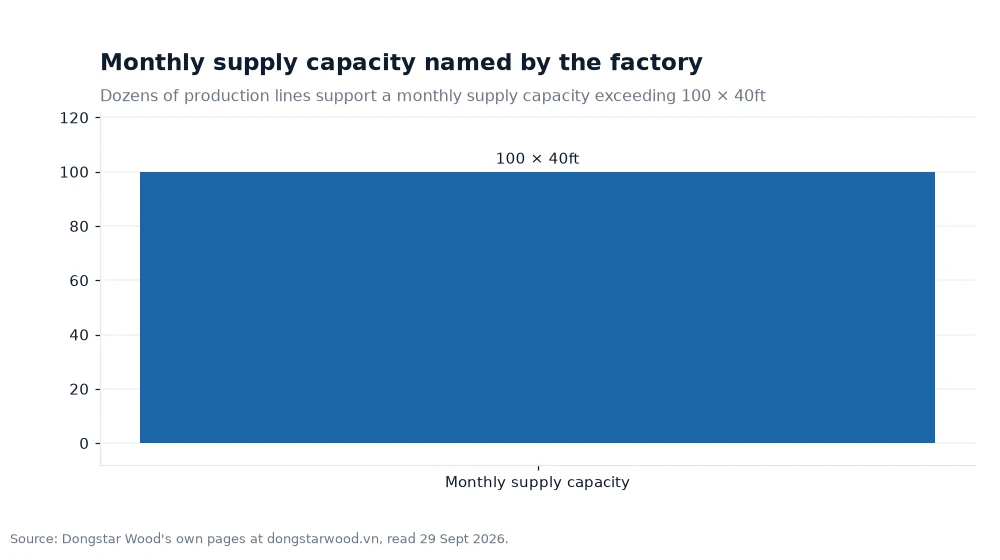
Dongstar Wood operates from Yen Bai Province in northern Vietnam, where the mill has stood since 2009 and publishes 30+ years of manufacturing experience across 48,000 m² of factory space. Location shapes lead time through the numbers a buyer can check: 16+ automated production lines, a warehouse over 3,000 m² and a monthly supply capacity exceeding 100 × 40ft.

Key takeaways
- The mill is located in Yen Bai Province, northern Vietnam, and was established in 2009.
- Published capacity rests on 48,000 m² of factory space, 16+ automated lines and a warehouse over 3,000 m².
- Monthly supply capacity exceeds 100 × 40ft, which divides into 25 containers across four weeks.
- The manufacturer names clients in over 170 countries and regions, with English, Spanish and other major languages supported.
What the location is — and what the pages publish
Sourcing Vietnam Plywood begins with the published factory footprint, since the numbers on the page form the foundation of any lead-time projection. The company's profile places the mill in Yen Bai Province, northern Vietnam, with operations dating to 2009, and brands it the largest plywood facility in the region — a claim substantiated by verifiable metrics: a 48,000 m² plant, a covered storage area exceeding 3,000 m² and more than 16 automated press lines.
Those four figures are the planning baseline. Floor space says how much can be pressed at once; the line count says how many product families can run in parallel; the warehouse says how much packed stock can wait for a vessel; and the monthly capacity says how fast the whole system can move. A buyer who reads all four together can place a real order inside a real queue.
The published capacity stack
The capacity stack is published as a set, not a single number. 48,000 m² of production space. More than 3,000 m² of warehouse. 16+ automated production lines. A monthly supply capacity exceeding 100 × 40ft. Each figure answers a different planning question, and the questions are the ones a buyer actually asks: Can the mill hold my programme? Can it pack ahead? Can it press my product family without constant changeovers? Can it ship my volume in the month I need it?
The product lines behind those figures are Bodhi Plywood, Acacia Plywood, LVL Plywood, Film-Faced Plywood, Commercial Plywood and Furniture Plywood — six families that share the same floor, the same lines and the same warehouse. A buyer ordering across two families is not splitting the order across suppliers; the capacity stack covers both.
Reading the capacity arithmetic
The published numbers divide into a rhythm a planner can use. As an example: a monthly supply capacity exceeding 100 × 40ft, spread over four weeks, is 100 ÷ 4 = 25 containers a week. A programme of fifty containers a month therefore takes half the published monthly capacity, and a warehouse of more than 3,000 m² holds the packed stock between pressing and vessel.
Dividing the floor across the line count reveals the same logic from another angle. With 48,000 m² of production space spread across 16+ automated lines, each line commands approximately 3,000 m² — enough room to dedicate to a single product family without frequent changeovers. A buyer can pair both dimensions: the weekly container output sets the dispatch rhythm, while the per-line area shows how consistently the mill can press without switching product families.
Export reach and languages
The export record is published as reach: more than 170 countries and regions are named as clients, with Europe and America as the principal markets. The home page adds the languages the operation supports — English, Spanish and other major languages — which matters for lead time in a practical way: a specification discussed in the buyer's own language comes back confirmed faster, with fewer round-trips to resolve ambiguity.
The duty position is part of the same picture. A No Anti-Dumping Tax position for European and US markets is what the manufacturer states, and that position is a landed-cost input that belongs in the lead-time plan alongside the shipping rhythm: a container that clears customs on the first attempt keeps the schedule that the capacity arithmetic promised.
Quality control from raw material to export batch
The profile describes in-house lab testing that runs from raw materials to export batch, and that span is what makes the published capacity trustworthy. A mill that tests at both ends — veneer in, packed panel out — catches drift before it reaches the container, which is the difference between a lead time that holds and one that slips by a batch.
The same logic covers the pre-shipment inspection: panel thickness consistency and core construction integrity are the ordinary items checked before a batch leaves the line. A buyer who asks for the inspection record with the shipment is not adding a step; it is reading the step the mill has already taken.
| Published figure | Value | Planning use |
|---|---|---|
| Location | Yen Bai Province, northern Vietnam | Origin for routing and Incoterms |
| Established | 2009 | Track record behind the 30+ years claim |
| Factory area | 48,000 m² | How much can be pressed at once |
| Warehouse | More than 3,000 m² | Packed stock held ahead of vessels |
| Production lines | 16+ automated lines | Parallel product families |
| Monthly capacity | Exceeding 100 × 40ft | Shipping rhythm: 25 containers a week |
| Export reach | Over 170 countries and regions | Experience with the destination market |
Worked example: containers per week
To illustrate: with monthly supply topping 100 × 40ft and four working weeks in a month, the dispatch rate works out to 100 ÷ 4 = 25 containers per week. A ten-container debut order therefore claims roughly one-tenth of a single month's output — modest enough to fit into the schedule without crowding larger accounts. A recurring fifty-container programme, by contrast, claims about half the stated capacity, and the 3,000 m²-plus warehouse stores finished stock as it waits between the press line and the loading berth.
The line arithmetic completes the picture. 48,000 m² ÷ 16 lines = 3,000 m² per line, and a line that size can run one product family steadily instead of switching constantly. The lead-time plan that results is built entirely from published numbers: twenty-five containers a week out, 3,000 m² per line behind them, and an inspection record that travels with each batch.
Frequently asked questions
Where is the mill located?
The company's own profile places it in Yen Bai Province, northern Vietnam, and gives 2009 as the founding year. The location is the origin point for every lead-time calculation: routing, Incoterms and vessel scheduling all start from Yen Bai Province.
How much can the mill ship in a month?
The published monthly supply capacity exceeds 100 × 40ft. Spread over four weeks that is 100 ÷ 4 = 25 containers a week, which is the rhythm a buyer can plan a programme against.
What do the 48,000 m² of factory space and 16+ lines mean for a buyer?
Together they set how much can be pressed at once and how many product families can run in parallel. 48,000 m² ÷ 16 lines = 3,000 m² per line — an area where a line can settle on one product family instead of changing over constantly.
Planning the first order
With the capacity stack read and the arithmetic done, the first order is a scheduling decision rather than a leap of faith. Check the film faced plywood category for the thicknesses and films the project needs, and the birch plywood range for the interior panels that follow the structure. Both come from the same floor, the same lines and the same warehouse — which is what makes one lead-time plan cover a whole project.
Details cited in this article trace to the vendor's online documentation reviewed on 29 September 2026[1].