
Scaling Connectivity: Technical Benchmarks of the Taoyaomen Bridge Completion
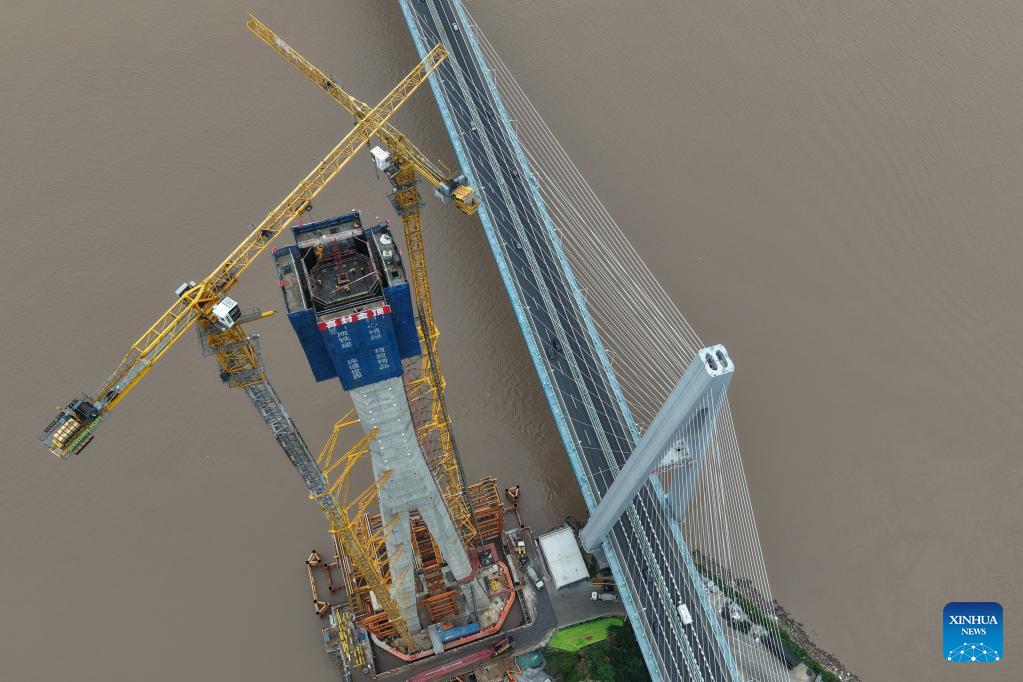
The recent topping out of the No. 5 main tower on the Taoyaomen highway-railway bridge in Zhejiang represents a significant milestone in high-capacity logistics and civil engineering. Reaching a final design height of 218 meters, this tower is more than just a vertical achievement; it serves as a critical structural node in the Ningbo-Zhoushan Railway project. From a technical standpoint, the completion of both main towers suggests that the project is successfully managing the high-load stresses inherent in a hybrid highway-railway system. These dual-purpose structures typically require a load-bearing capacity significantly higher than standard highway bridges, often managing a 30% to 50% increase in structural tension and vibration amplitude due to the passage of heavy-duty freight and passenger trains at high speeds.
This infrastructure is vital because it addresses the efficiency bottleneck of island-to-mainland transport. Zhoushan’s integration into the regional network relies on a bridge throughput that can handle massive daily traffic volume while maintaining strict safety certifications. For a project of this scale, the construction precision often involves a tolerance range of less than 10-20 millimeters over the 218-meter span. According to reports from the People's Daily, the strategic expansion of China’s high-speed rail and highway networks continues to drive down logistics costs while improving the ROI for regional industrial hubs. By reducing travel time and increasing the frequency of transport cycles, the bridge serves as a catalyst for economic growth in the Yangtze River Delta, where trade density is among the highest in the world.
Looking at the engineering specifications, a bridge tower of 218 meters utilizes thousands of tons of high-strength steel and tens of thousands of cubic meters of specialized concrete. The project must account for a wind load resistance capable of withstanding typhoon-level gusts, which are frequent in Zhejiang, sometimes reaching speeds exceeding 50 meters per second. The technical application of sensors and real-time monitoring platforms ensures that the oscillation frequency and structural integrity remain within the safe operating margin throughout its 100-year design life. Furthermore, the construction management by China Railway Major Bridge Engineering Group likely focused on a rigorous 24-hour operation cycle to meet the May deadline, balancing high-intensity labor with automated precision tools to maintain a steady growth rate in elevation.
To optimize future maintenance and operational safety, integrating a comprehensive Digital Twin model could be a viable solution. By deploying an array of IoT sensors across the 218-meter towers, engineers can track structural fatigue, humidity levels, and pressure distribution with a data accuracy of 99.9%. This proactive strategy would allow for a reduction in maintenance budgets by up to 15% over the first decade of the bridge’s lifespan. As the project moves into the deck-laying and cable-stayed installation phases, the focus will shift to tensioning accuracy and the synchronization of the highway and railway segments. This level of infrastructure investment reflects a broader strategy to enhance supply chain resilience and urban connectivity through massive, data-driven engineering solutions.
News source: https://peoplesdaily.pdnews.cn/china/er/30052088185