
EDP vs EDT vs Parfum: Perfume Concentration Levels Compared
Concentration is the share of perfume oil in the product, and it is the first performance decision a new fragrance line makes. Parfum, eau de parfum, eau de toilette and eau de cologne differ in oil percentage, weight of wear and cost per bottle — and the label alone does not tell you which one your customers want. Choose concentration by how and where the product will be worn, not by prestige.
Key takeaways
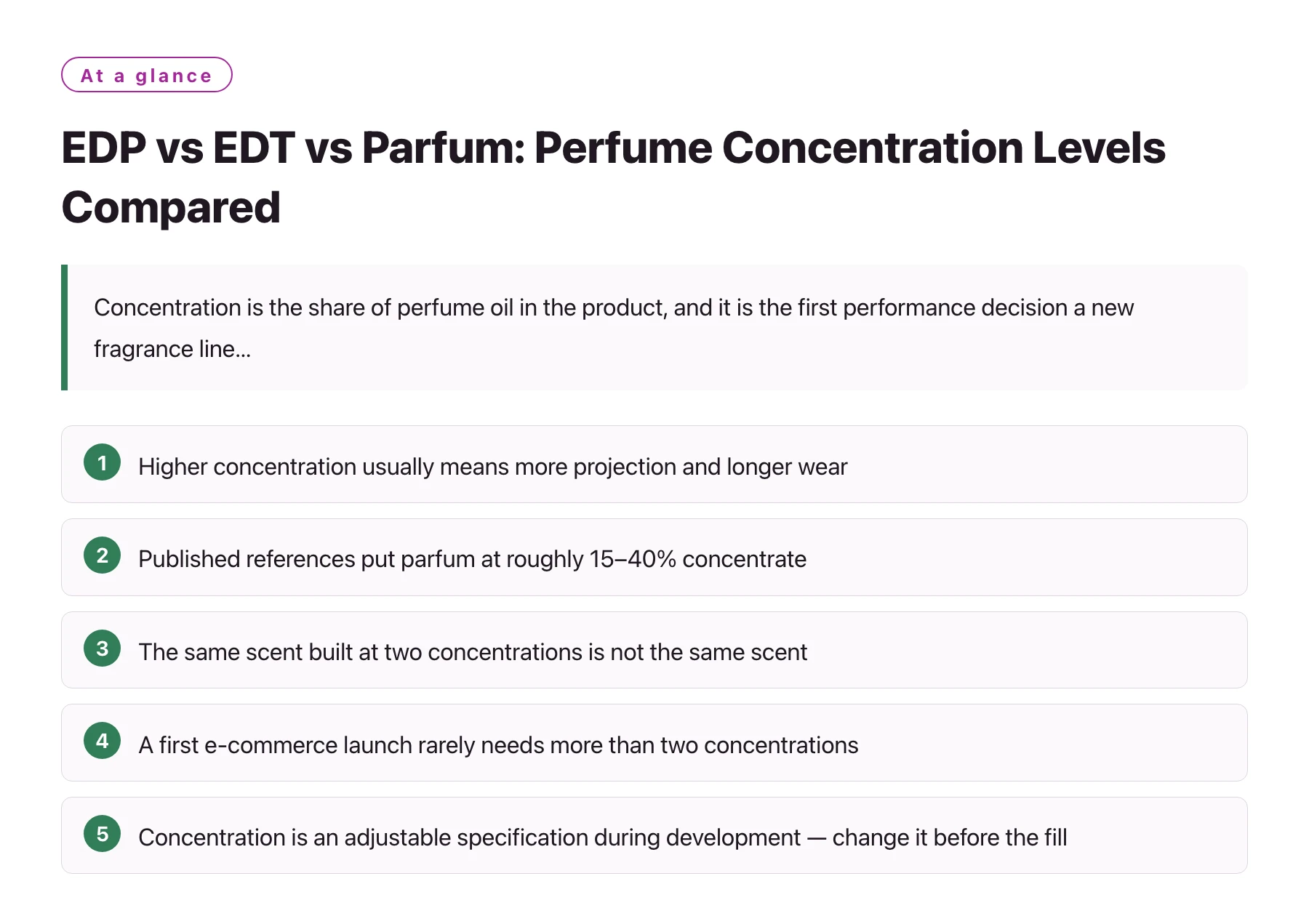
- Higher concentration usually means more projection and longer wear, but it also raises cost and can feel heavier in use.
- Published references put parfum at roughly 15–40% concentrate, with eau de parfum and eau de toilette lower still — ranges, not laws.
- The same scent built at two concentrations is not the same scent; dilution changes how the notes unfold.
- A first e-commerce launch rarely needs more than two concentrations; extra SKUs dilute sampling.
- Concentration is an adjustable specification during development — change it before the fill, not after the first batch.
Walk down any fragrance aisle and the labels read like a hierarchy: parfum, eau de parfum, eau de toilette, eau de cologne. Most shoppers read it as quality — more expensive label, better product. The truth is more useful and more practical: the labels describe how much perfume oil sits in the bottle, and that number is a design decision, not a grade.
For a brand planning its first line, concentration is the specification that connects the formula to the price, the pack size and the customer's expectation. This article compares the labels and gives a decision path for choosing yours.
What the concentration number really is
A fragrance product is mostly a carrier — usually alcohol, sometimes water or oil — with a share of perfume concentrate. That share is the concentration, and it is what the label names. Published overviews of the categories commonly cite parfum at about 15–40% concentrate, eau de parfum lower, and eau de toilette lower still, with cologne and fraiche at the bottom of the range [1].
Two practical facts follow. First, concentration and performance are related but not identical: a high-concentration product projects louder and lasts longer, but the wearer's skin chemistry and the materials themselves matter as much. Second, ingredient references such as The Good Scents Company list suggested use levels per material, which is where the practical ceiling of a concentration shows up — some materials dominate a light dilution and disappear in a heavy one [2].
The labels, side by side
| Label | Typical oil share | Wear profile | Best fit |
|---|---|---|---|
| Parfum (extrait) | Roughly 15–40% | Longest wear, strongest presence | Evening, small sizes, hero product |
| Eau de parfum | Roughly 10–20% | Full day on most skin | The standard e-commerce hero SKU |
| Eau de toilette | Roughly 5–15% | A few hours, lighter | Warm climates, casual wear, travel sizes |
| Eau de cologne / fraiche | Roughly 1–8% | Brief and refreshing | Body sprays, aftershave, summer lines |
Treat the ranges as industry convention rather than regulation; different manufacturers and markets label differently, so always ask for the actual percentage in the formula specification.
Choosing for a first line
Match the concentration to the occasion
The customer does not buy a percentage; they buy a behaviour. A scent for the office commute asks for a lighter wear, a scent for evenings asks for presence. Premium lines usually default upward — high-end perfume production rarely starts below eau de parfum, because the customer in that tier expects the scent to announce itself high-end perfume production.
One hero, one flanker
A first launch with one eau de parfum hero and one lighter flanker — often the same base at eau de toilette strength — covers the two main occasions without multiplying SKUs. Releasing the same formula at two dilutions is a common move in custom fragrance R&D and production because the second SKU reuses an approved base custom fragrance R&D and production.
Remember the carrier
Not every format is alcohol-based. Oil-based perfumes, solid formats and body mists work without the traditional dilution ladder, and some customers prefer them for skin sensitivity. If the brief targets those formats, the concentration conversation changes completely — state the carrier in the brief.
Concentration in the development conversation
The fastest way to burn a sampling budget is to treat concentration as fixed. During development it is a dial: the same base can be evaluated at two strengths before the fill, and the difference in wear is visible in one test day. A closer read of how dilution changes performance — the argument behind every label — is exactly what the explainer on dilution levels in fine fragrance covers, and it is worth reading before the first sample round dilution levels in fine fragrance.
When the brief goes to the factory, write the target concentration and the carrier explicitly, and ask for the actual percentage back in the specification. The label is marketing; the percentage is the specification, and the two should agree.
One more reason to pin the number down: duty and freight are calculated on weight, and a heavier concentrate raises the shipped weight of the finished bottle. Across a container, the difference between an eau de toilette and an eau de parfum version of the same SKU shows up in the logistics line, not just the formula line — yet another reason the concentration decision belongs early, in the brief, with the numbers attached.
Sources
- Wikipedia: Perfume —— An encyclopaedic overview of perfume covering definitions, history, the note structure of a fragrance and concentration terminology (background reference only).
- The Good Scents Company —— A reference database of aroma materials with odour descriptions, CAS numbers and typical usage information.
Frequently asked questions
Is eau de parfum always stronger than eau de toilette?
Usually, because it carries more concentrate, but not always in perception. The materials and the wearer's skin can make a well-built eau de toilette project longer than a thin eau de parfum. Compare percentages, not labels.
Can the same formula be released in two concentrations?
Yes, and it is a common line strategy. The notes unfold differently at each dilution, so treat them as two products and approve each separately rather than diluting one approval.
Does higher concentration mean better quality?
No. Quality lives in the materials and the composition; concentration is a choice. A poor formula at 25% still smells poor, just longer.
What concentration should a first launch use?
Eau de parfum is the safe default for a hero e-commerce SKU, with a lighter flanker if the range can afford it. Match the choice to where the customer wears the product, not to what sounds prestigious.
Why does my skin change how long a scent lasts?
Skin temperature, moisture and chemistry affect evaporation and how materials bind. The same product can perform very differently on two people, which is why evaluation should include several wearers.