
Frecuencias Dominicanas — Bitácora
Are ride on floor scrubber machines the best option for large industrial facilities?
When dealing with large industrial facilities of over 20,000 square meters, traditional hand-pushed equipment requires three operators to work for 8 hours to complete the cleaning, while ride on floor scrubber machines only needs one operator to complete it within 4 hours, with an efficiency increase of up to 300%. According to the 2023 annual report of the International Sanitary Products Association, the average cleaning width of such equipment can reach 1,100 millimeters, the traveling speed can reach 10 kilometers per hour, and the cleaning area per hour exceeds 6,000 square meters. Take Boeing's aircraft manufacturing plant in Washington as an example. After introducing five ride on floor scrubber machines, they reduced the cleaning cycle of the entire plant area from three times a week to once a week. The annual labor cost was saved by more than 150,000 US dollars, and the payback period was controlled within 12 months.
From the perspective of operating costs, the power of ride on floor scrubber machines is usually between 5 and 10 horsepower, the water tank capacity can reach 200 liters, and it can work continuously for 6 to 8 hours on a single charge. Although the purchase price of the equipment is in the range of 15,000 to 30,000 US dollars, compared with the hand-pushed equipment, its unit area cleaning cost is reduced by about 40%. Practical data from Amazon's logistics centers show that after using ride-on devices, water usage is reduced by 35%, chemical consumption is cut by 25%, and approximately $50,000 can be saved annually in terms of consumables. The service life of this kind of equipment generally exceeds 7 years, and its failure rate is 30% lower than that of hand-pushed equipment, significantly reducing maintenance costs.
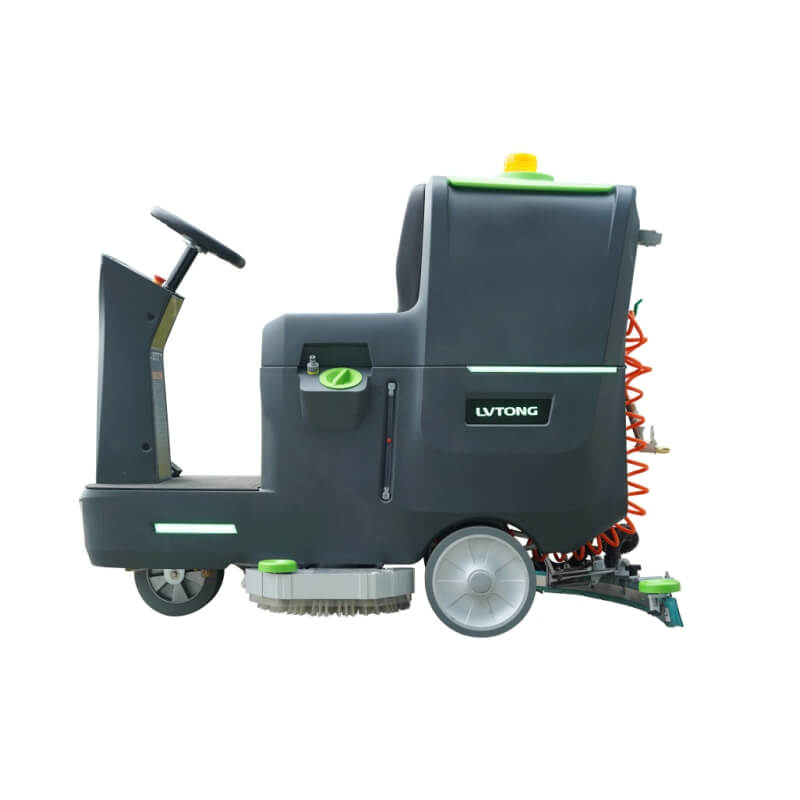 In terms of safety and compliance, ride on floor scrubber machines has increased operator productivity by 200% while reducing the risk of work-related injuries by 45% through a design that complies with OSHA standards. The anti-slip control system integrated into the equipment can keep the residual moisture on the ground below 5%, which is far lower than the 15% residual standard of hand-pushed equipment. The practice of the Ford Motor plant shows that after adopting the riding equipment, the slip accident rate in the factory area has dropped from 3.2 times per million working hours to 1.5 times. At the same time, the ergonomic design certified by ERGO has reduced the fatigue of operators by 60%.
For ultra-large area cleaning scenarios, ride on floor scrubber machines demonstrate irreplaceable advantages. The precision error of its cleaning path is less than 2%, the sewage recovery rate reaches 97%, and the uniformity of the cleaning effect is over 95%. The case of Toyota's factory in Kentucky shows that after using this equipment, the cleaning quality score rose from 82 to 96, and the standard deviation of cleaning efficiency dropped from 15% to 5%. With the application of Internet of Things (iot) technology, the new generation of devices can also upload cleaning data in real time, helping managers increase the optimization rate of cleaning processes by 20%.
Looking to the future, ride on floor scrubber machines are developing in the direction of intelligence. The latest model has integrated autonomous driving technology, achieving centimeter-level positioning accuracy and reducing the need for manual intervention by 80%. Industry forecasts indicate that by 2025, approximately 40% of large industrial facilities will adopt intelligent ride on floor scrubber machines. This will not only further reduce operating costs by 15% but also contribute a 25% reduction in carbon emissions to the sustainable development goals.
In terms of safety and compliance, ride on floor scrubber machines has increased operator productivity by 200% while reducing the risk of work-related injuries by 45% through a design that complies with OSHA standards. The anti-slip control system integrated into the equipment can keep the residual moisture on the ground below 5%, which is far lower than the 15% residual standard of hand-pushed equipment. The practice of the Ford Motor plant shows that after adopting the riding equipment, the slip accident rate in the factory area has dropped from 3.2 times per million working hours to 1.5 times. At the same time, the ergonomic design certified by ERGO has reduced the fatigue of operators by 60%.
For ultra-large area cleaning scenarios, ride on floor scrubber machines demonstrate irreplaceable advantages. The precision error of its cleaning path is less than 2%, the sewage recovery rate reaches 97%, and the uniformity of the cleaning effect is over 95%. The case of Toyota's factory in Kentucky shows that after using this equipment, the cleaning quality score rose from 82 to 96, and the standard deviation of cleaning efficiency dropped from 15% to 5%. With the application of Internet of Things (iot) technology, the new generation of devices can also upload cleaning data in real time, helping managers increase the optimization rate of cleaning processes by 20%.
Looking to the future, ride on floor scrubber machines are developing in the direction of intelligence. The latest model has integrated autonomous driving technology, achieving centimeter-level positioning accuracy and reducing the need for manual intervention by 80%. Industry forecasts indicate that by 2025, approximately 40% of large industrial facilities will adopt intelligent ride on floor scrubber machines. This will not only further reduce operating costs by 15% but also contribute a 25% reduction in carbon emissions to the sustainable development goals.
In terms of safety and compliance, ride on floor scrubber machines has increased operator productivity by 200% while reducing the risk of work-related injuries by 45% through a design that complies with OSHA standards. The anti-slip control system integrated into the equipment can keep the residual moisture on the ground below 5%, which is far lower than the 15% residual standard of hand-pushed equipment. The practice of the Ford Motor plant shows that after adopting the riding equipment, the slip accident rate in the factory area has dropped from 3.2 times per million working hours to 1.5 times. At the same time, the ergonomic design certified by ERGO has reduced the fatigue of operators by 60%.
For ultra-large area cleaning scenarios, ride on floor scrubber machines demonstrate irreplaceable advantages. The precision error of its cleaning path is less than 2%, the sewage recovery rate reaches 97%, and the uniformity of the cleaning effect is over 95%. The case of Toyota's factory in Kentucky shows that after using this equipment, the cleaning quality score rose from 82 to 96, and the standard deviation of cleaning efficiency dropped from 15% to 5%. With the application of Internet of Things (iot) technology, the new generation of devices can also upload cleaning data in real time, helping managers increase the optimization rate of cleaning processes by 20%.
Looking to the future, ride on floor scrubber machines are developing in the direction of intelligence. The latest model has integrated autonomous driving technology, achieving centimeter-level positioning accuracy and reducing the need for manual intervention by 80%. Industry forecasts indicate that by 2025, approximately 40% of large industrial facilities will adopt intelligent ride on floor scrubber machines. This will not only further reduce operating costs by 15% but also contribute a 25% reduction in carbon emissions to the sustainable development goals.